The Same Name, Two Different Drugs
What CJC-1295 Actually Means
Two products sold under one name. One clears your system in about thirty minutes. The other is still circulating a week later.
Two vials sit on a shelf. Both labels read CJC-1295. Both contain a real compound. Both are what they say they are.
One of them clears your system in about half an hour. The other is still circulating a week later.
Not a potency difference. Not a quality difference. They are different molecules — related, but built to do different things on different timescales — and they are sold, discussed, and dosed under a single name as though the distinction were a footnote.
It isn't a footnote. It's the whole molecule. And if you can't tell which one you're holding, nothing else you know about it matters much.
Two molecules, one name
Start with the shared part. Both versions are built on a fragment of growth hormone-releasing hormone — the signal your hypothalamus normally sends to your pituitary. Both have been modified to survive longer in blood than the natural version, which is degraded within minutes.
That's where they part company.
The original design carries something called a Drug Affinity Complex — DAC. In practice, that's a reactive chemical group (on a modified lysine) at the end of the peptide. It has one job: as soon as the molecule enters the bloodstream, that group forms a permanent, covalent bond with albumin — the same class of bond holding the molecule together in the first place. Once it forms, it doesn't come apart.
The consequence is that the peptide stops behaving like a peptide and starts behaving like albumin. Albumin is large, and your kidneys don't filter it out. Albumin circulates for weeks. A peptide latched onto albumin inherits that ride.
Reported half-life for the DAC version (plasma, from published human studies): roughly six to eight days.
The other version is the same peptide without that group — commonly sold and discussed as "modified GRF (1-29)." Everything else about it is similar. It still has modifications that help it resist the enzymes that would otherwise chew it up. But nothing anchors it to albumin, so the kidneys clear it the way they clear any small molecule — quickly.
Reported half-life: roughly thirty minutes.
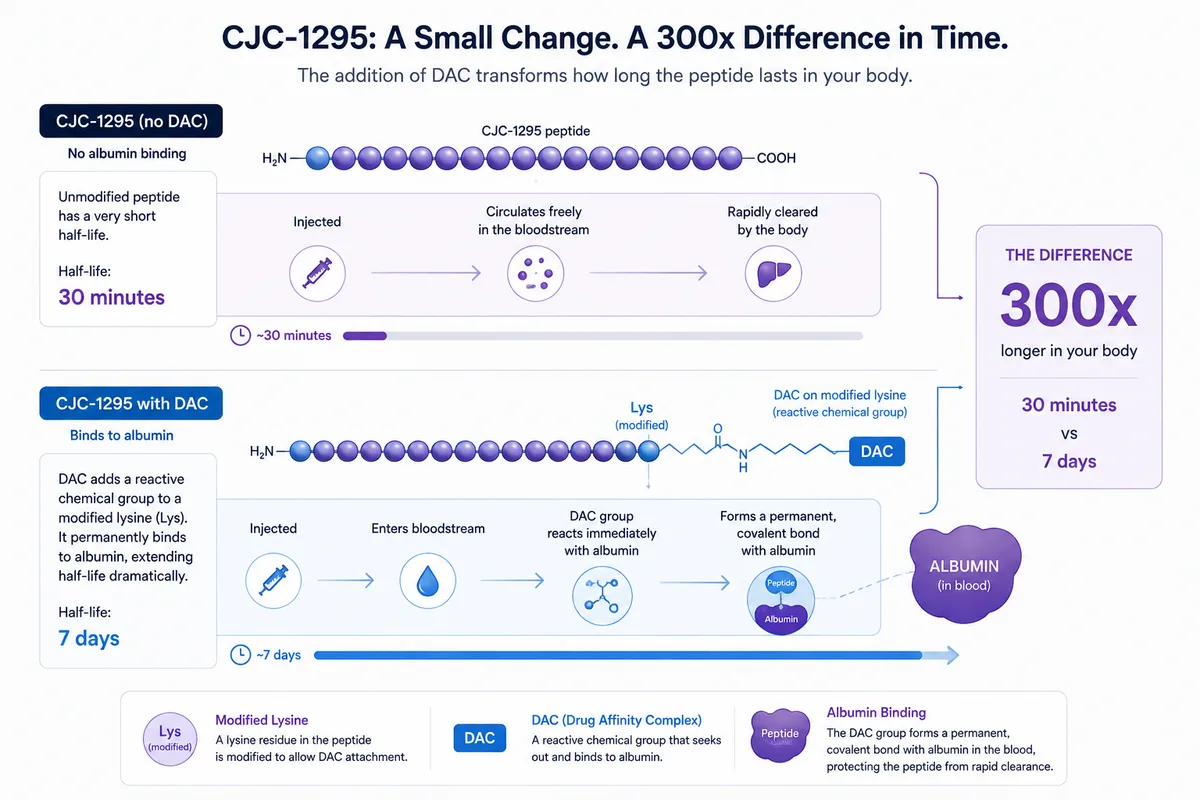
Thirty minutes against seven days is a difference of roughly three hundred-fold.
For comparison: that's the gap between a drug you'd need to infuse continuously and one you'd take weekly. In any other context, nobody would call those the same product.
Why the ambiguity is dangerous, not just sloppy
Two molecules with a 300-fold difference in duration need fundamentally different handling. Not adjusted handling. Different in kind.
Something cleared in half an hour produces a brief spike and then nothing. Something that persists for a week produces continuous, uninterrupted exposure.
And the error runs in a specific direction. If you treat the long-acting version as though it were the short-acting one — dosing it on the assumption that it's gone by the time you dose again — it isn't gone. Each dose adds to what's still circulating. Levels climb steadily, and they climb without anything in the schedule signaling that it's happening.
There's a second problem underneath the first. The system these compounds act on is designed around pulses. Your body doesn't release growth hormone in a steady stream; it releases it in bursts, mostly overnight, with quiet periods in between. Those quiet periods aren't downtime — they're part of how the system works. Receptors that are stimulated without pause become less responsive to stimulation. A molecule engineered for continuous presence is, by design, working against that rhythm.
That's a real pharmacological question with real tradeoffs, and reasonable people have argued it. But you can't even begin the argument if you don't know which molecule is in the vial.
A necessary note: CJC-1295 is not an approved drug in the United States, the EU, or any other major market, in either form. (The FDA has evaluated the with-DAC and without-DAC forms — and different salt forms — separately, a regulatory acknowledgement that they aren't interchangeable.) Clinical development was discontinued. There is no established human dosing for it, no approved indication, and no regulatory oversight of what's sold under the name. Nothing in this article should be read as suggesting otherwise. It appears here because it's the clearest available illustration of a problem that runs through the entire category.
The pattern: names in this space aren't identifiers
CJC-1295 is not an unlucky exception. It's a symptom of how this corner of the market names things.
Approved drugs get names through a formal process. An international body assigns each one a unique generic name — semaglutide, octreotide, tesamorelin — and that name maps to exactly one molecule, with a defined structure, in a public record. When a doctor writes "tesamorelin," there is no ambiguity about what that is. That's the entire point of the system.
Compounds that never completed development never entered that system. They kept their laboratory codes. CJC-1295 is a code. TB-500 is a code. BPC-157, GHRP-6, MK-677 — all codes, assigned by whoever was working on them at the time, governed by no naming authority and subject to no discipline whatsoever.
Codes drift. They get applied loosely, extended to related compounds, and reused for things the original researchers never made.
The same problem, elsewhere in the category:
- TB-500 sometimes refers to thymosin β4, a 43-amino-acid protein. Sometimes it refers to a seven-amino-acid piece of it. Those are not the same molecule, and — as we'll cover in a later article — a regulatory boundary runs directly between them.
- Melanotan I and Melanotan II are distinct compounds, routinely conflated in casual discussion despite meaningfully different properties.
- GHRP variants are frequently written as though interchangeable.
The absence of a proper name is itself informative. It tells you the compound never got far enough through development for anyone to assign it one — which tells you something about how much is actually known.
What a real specification looks like
Here's the standard the pharmaceutical industry uses. Every element earns its place.
- Systematic or generic name — the one that maps to a single molecule
- Full amino acid sequence — the actual structure, verifiable against a reference
- All modifications — including, in this case, DAC status; these determine how the molecule behaves in the body
- Molecular weight — lets you check identity testing against an expected value
- Salt form — affects what a stated weight actually contains, since a milligram of salt is not a milligram of peptide
- Supplier and lot number — traceability, without which a problem can't be tracked to a source
Any one of those missing is a gap. The modifications line is the one that separates a seven-day molecule from a thirty-minute one.
Where this goes
You now have the first tool: a name is not a molecule. When you encounter a peptide referred to by name alone, the reflex to build is which version?
That reflex on its own will catch a surprising amount. But it's one of nine.
Over the next eight articles we'll add the rest. How to decode a drug name and read its classification straight off it. Why nearly every peptide has to be injected, and what it took to make the one exception work. The single number that determines whether a compound can be legally compounded. How a daily injection became a weekly one, and what that engineering cost. Why cutting a piece out of a hormone doesn't reliably give you a smaller hormone. Why more isn't more. And the interaction risk that gets missed before surgery.
By the last article, we'll put a protocol on the table — the kind circulating right now, that thousands of people follow — and take it apart line by line. You'll do most of the work yourself, because you'll already have every tool it takes.
That's the point of the series. Not to tell you what to think about any of these compounds. To make you the person who can work it out.
A note about our naming shortcuts
Scientific drug nomenclature gets complicated quickly — useful for a researcher, pharmacist, or clinician, but often more than you need just to follow the biology. So throughout this series we use plain-language descriptions and simplified naming wherever we can ("peptide," "GLP-1 agonist," "dual agonist") rather than stacking formal nomenclature on you up front.
These are educational shortcuts, not replacements for the formal terminology. When a precise distinction actually changes the answer — as "with DAC" versus "without DAC" just did — we'll introduce the proper term and explain it before we expect you to use it.
Simple first. Precise when it matters.
This article is educational and not medical advice. It does not recommend any compound, dose, or protocol. CJC-1295 is not approved for human use in any major market. Decisions about any therapy belong with a qualified clinician who knows your history.