Two Amino Acids Separate Bonding From Blood Pressure
Drug Names, Decoded: The Hidden Grammar of Peptides
Oxytocin and vasopressin differ by two amino acids out of nine. One governs childbirth and bonding. The other governs water balance and blood pressure.
Here are two hormones your body makes. Both are nine amino acids long. Both are made in the same region of your brain and released from the same gland.
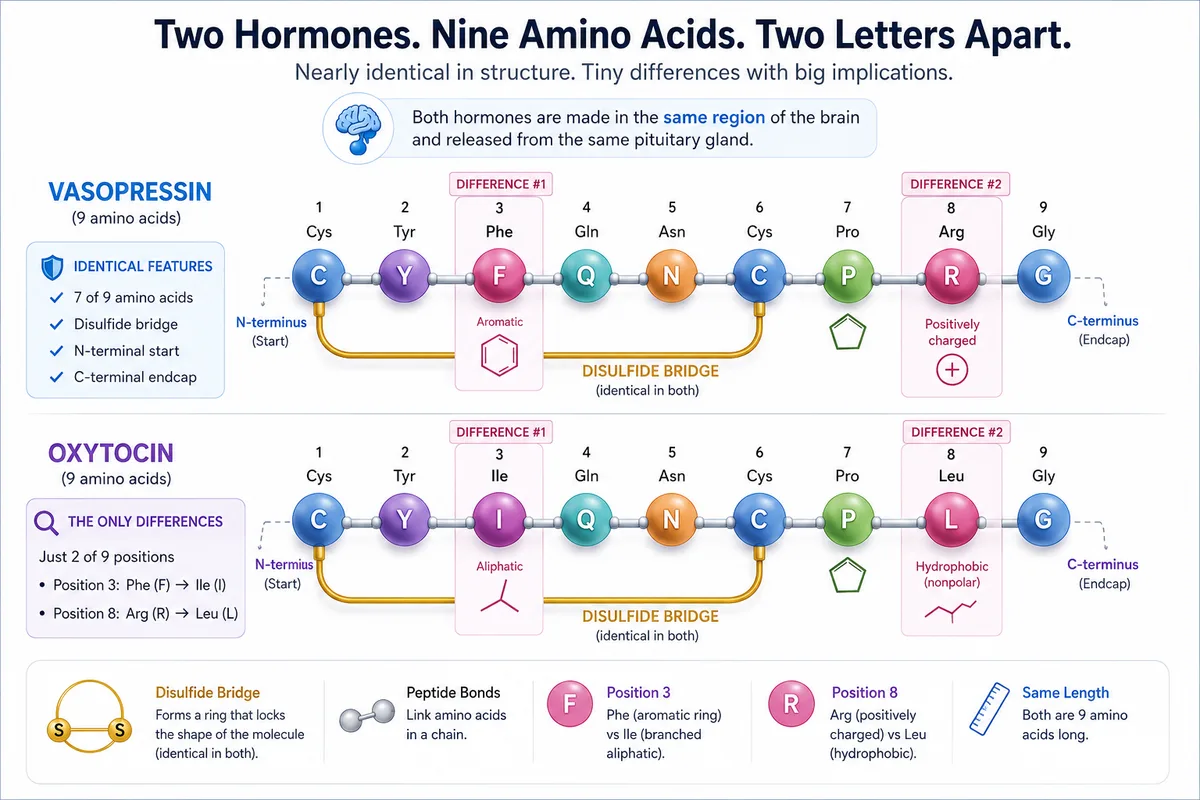
Seven of nine positions are identical. The chemical ring holding each molecule together is identical. The cap on the end is identical.
Vasopressin controls how much water your kidneys retain, and it tightens your blood vessels. It's the reason you don't dehydrate overnight.
Oxytocin drives uterine contractions during labour and milk release during nursing. It's the hormone that shows up in every article about trust and bonding.
Two positions. Completely different physiology.
They aren't even distant relatives. The genes sit next to each other on chromosome 20, pointed in opposite directions — the signature of an ancient gene duplication. One molecule became two, they drifted by two residues, and evolution assigned them entirely separate jobs.
The lesson: there is no such thing as a minor modification
That's the point worth carrying out of this article.
Two changes out of nine is, by any intuitive measure, a small edit. Roughly 78% of the molecule is untouched. If you were told a compound had been modified at two positions, "modified" would sound like a tweak.
It isn't a tweak. It's a different hormone with a different receptor and a different job.
Nature isn't perfect at this, incidentally, and the imperfection is instructive. Two residues isn't quite enough for total separation: at high enough concentrations, oxytocin has meaningful activity at vasopressin's water-retention receptor. This is a documented clinical problem — prolonged oxytocin infusion during labour can cause the body to retain too much water, diluting blood sodium to dangerous levels. Hospitals monitor for it.
So even after millions of years of divergence, two molecules two residues apart still bleed into each other's territory.
Hold that next to a common claim in the peptide market: that some compound is "essentially the same as" an approved drug, or a "slightly modified version" of a known hormone.
Slightly modified compared to what? Oxytocin is a slightly modified vasopressin. It causes labour.
The magnitude of a structural change does not predict the magnitude of the biological change. It never has. Any claim built on "it's only a small difference" is making an assumption the chemistry doesn't support.
Names as a decoder ring
That's the first half. Here's the second, and it's more immediately useful.
Article 1 covered how a peptide's name can fail to identify which molecule you're getting. The flip side is that when a compound does have a proper name, that name is packed with information — and almost nobody reads it.
Approved drugs receive an International Nonproprietary Name through a formal process. These names aren't invented by marketing departments. They're assembled from standardized components, and the ending — the stem — encodes the drug's pharmacological class.
Learn a dozen stems and you can classify a drug you've never encountered.
Three words appear repeatedly in the table below, so it's worth pinning them down first.
Look at that table alongside the top of this article. Vasopressin analogs end in -pressin. Oxytocin analogs end in -tocin. The naming system encodes the same split that two amino acids created — the pharmacology and the vocabulary agree.
Encounter an unfamiliar name like dulaglutide and the stem alone tells you real things: -tide marks it as a peptide, -glutide marks it as a GLP-1 receptor agonist, and because it's a peptide it's almost certainly injectable. Three useful facts before you've looked anything up — and all of them from official family stems, not from any counting trick.
One letter, opposite drugs
Now look again at two rows in that table.
-relin — stimulates a hormone release. -relix — blocks it.
One letter. Opposite mechanisms. And this pair has genuine clinical consequences.
Both act on the system controlling testosterone production, and both are used in prostate cancer, where the goal is to shut testosterone down. But they get there by opposite routes.
A -relix drug blocks the signal directly. Testosterone falls within days. Nothing else happens on the way.
A -relin drug does the opposite first. It's an agonist — it stimulates the receptor. Flood the system with continuous stimulation and it eventually shuts down through exhaustion and receptor downregulation, which is the desired endpoint. But before the shutdown, there's a surge. Testosterone rises sharply for the first week or two.
That surge has a clinical name — the flare — and in a patient with cancer that responds to testosterone, a temporary spike is precisely the wrong direction. In men with spinal metastases or urinary obstruction, the flare can cause real harm during the window before suppression takes hold. It's managed with additional medication, or avoided entirely by choosing a -relix drug when speed matters.
Same target. Same therapeutic goal. Opposite immediate effect. One letter of difference in the name.
The stems aren't trivia. They encode mechanism, and mechanism is what determines what happens in the first two weeks.
When the category itself is wrong
There's one more failure mode, and it's the most common of all: a compound filed under the wrong category entirely.
MK-677 — ibutamoren — is discussed, sold, and stacked as a peptide throughout this space. It is not a peptide. It has no chain of amino acids. It's a conventional small molecule, structurally more like a typical pharmaceutical tablet ingredient than like anything else in this article.
It does hit the same receptor as several peptide compounds, which is where the confusion comes from. But sharing a target doesn't make two molecules the same class, and three practical consequences follow immediately from the chemistry:
It's taken orally. Peptides are destroyed by digestion — that's the subject of the next article. MK-677 has no peptide backbone to destroy, so it survives the stomach and can be swallowed.
Its effects are continuous, not pulsed. Peptide compounds acting on this system clear in minutes, producing brief bursts. Once-daily oral dosing of MK-677 produces sustained elevation around the clock. Whether that's good or bad is a real debate — the system it acts on is naturally pulsatile, which we'll come back to — but it's a fundamentally different exposure pattern.
It can interact with other medications. Peptides largely avoid the liver-enzyme competition behind most drug interactions. MK-677 is metabolized by exactly that machinery, which means real interaction potential that genuinely doesn't apply to the peptides it gets grouped with. Anyone who inherited the assumption "peptides don't have drug interactions" and applied it here has inherited it wrongly.
(MK-677 is not an approved drug. It went through clinical development and did not gain approval for its intended uses.)
File it under "peptide" and you inherit four assumptions — injectable, short-acting, pulsatile, interaction-free — and all four are wrong.
Two skills, not one
This article asked you to hold two things that pull in opposite directions.
Names carry real information. Stems encode class and mechanism, and reading them gives you a fast, reliable first classification of anything with a proper name.
Names also mislead. They get applied to the wrong category, extended to compounds they were never meant for, and — as Article 1 covered — used for multiple different molecules at once.
The skill is knowing which situation you're in. A proper name with a recognized stem is genuine evidence. A laboratory code is a label, and labels don't constrain what's underneath them.
Next, we go after the assumption underneath nearly every peptide product on the market: that it has to be injected. That isn't a business decision or a marketing choice. It's a consequence of what these molecules are made of — and the single exception took a permeation enhancer, a strict fasting protocol, and a specific volume of water to achieve about 1% absorption.
This article is educational and not medical advice. It does not recommend any compound, dose, or protocol. Several compounds mentioned are not approved for human use. Decisions about any therapy belong with a qualified clinician who knows your history.