Why It Has to Be Injected
Why Almost Every Peptide Is an Injection
Making oral semaglutide work required a permeation enhancer, strict fasting, a specific water volume — and it still only absorbs about one percent.
Your digestive system is a protein-disassembly machine. It's been refined over a very long time to take chains of amino acids and reduce them to their component parts, because that's how you extract nutrition from a meal.
A peptide is a chain of amino acids.
Your body cannot tell the difference between a therapeutic peptide and a piece of chicken. It doesn't try. Both are the same class of material, both are attacked by the same enzymes, and both end up in the same place — broken into fragments too small to do anything.
That's the entire reason nearly every peptide on the market is an injection. Not regulation. Not tradition. Not a business decision. Chemistry.
The gauntlet
Follow a peptide capsule from swallow to bloodstream. Four things happen, in order.
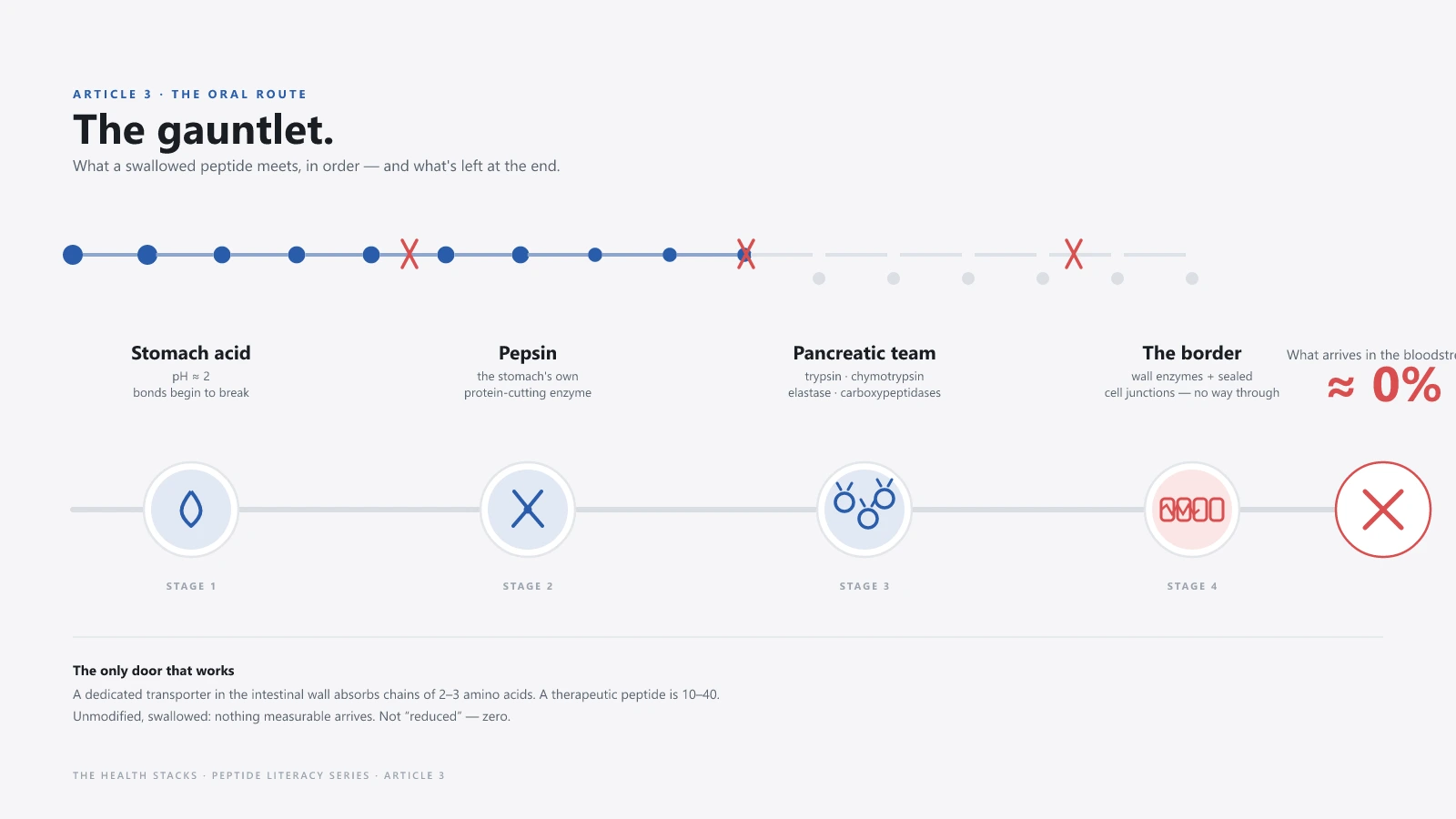
Acid. Your stomach runs at a pH of around 2 — corrosive enough that the stomach lining needs a dedicated mucus layer to avoid digesting itself. Most peptides begin unravelling here. Some bonds break outright.
Pepsin. The stomach's dedicated protein-cutting enzyme, active in exactly those acidic conditions. It cuts preferentially next to certain amino acids, and most therapeutic peptides contain several of them.
The pancreatic team. Whatever survives the stomach reaches the small intestine and meets a coordinated set of enzymes secreted by the pancreas. Trypsin cuts after one pair of amino acids. Chymotrypsin cuts after another. Elastase handles a third group. Carboxypeptidases work in from the end of the chain, removing one residue at a time. These aren't redundant — they're complementary, covering between them nearly every cleavage point a chain can offer.
The border. Anything still intact meets the surface of the intestinal wall, which carries yet another layer of enzymes for finishing the job.
The system's output is single amino acids and fragments two or three units long. There's even a dedicated transporter in the intestinal wall for absorbing those short fragments — but it only handles chains of two or three. Anything longer isn't recognized.
A typical therapeutic peptide is ten to forty amino acids. It's an order of magnitude too large for the only door available.
The second wall
Suppose a peptide somehow survived all of that intact. It still has to cross the intestinal wall.
That wall is a sheet of cells packed tightly together, sealed at their edges by structures called tight junctions. Two possible routes: through a cell, or between two cells.
Through requires crossing a fatty membrane, and peptides are water-loving molecules that don't dissolve into fat. Between requires fitting through the tight junctions, which are sized to exclude anything much larger than a small ion.
Neither route is available. Even a hypothetically indestructible peptide would mostly just pass through you.
The exception, and what it cost
One peptide has been made to work orally at scale. Looking at what that required is the fastest way to understand why the others haven't.
Semaglutide — the GLP-1 drug — exists in an oral form. It works. It's approved. And every element of how it works is a workaround for a problem in the sections above.
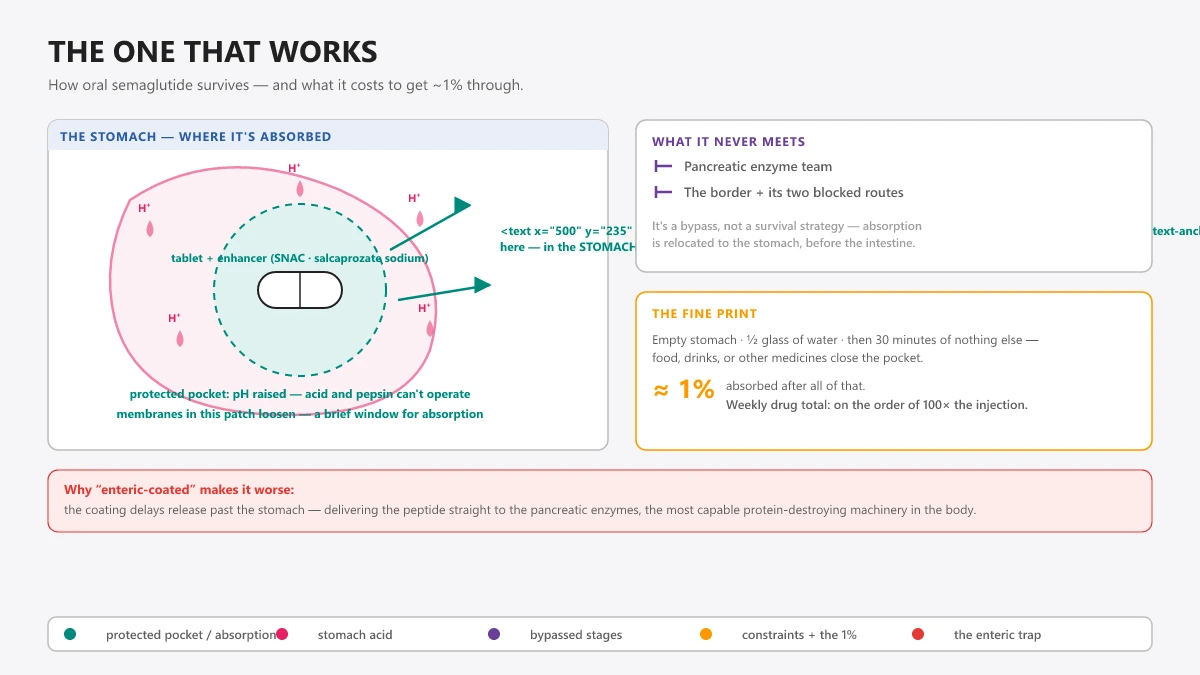
It's co-formulated with an absorption enhancer called salcaprozate sodium (SNAC). The tablet contains this second compound whose only job is to help the peptide survive and cross. It raises the pH immediately around the tablet, creating a small protected pocket where stomach acid and pepsin can't operate. It also temporarily loosens the cell membranes in that patch of stomach lining, opening a window through which some drug can pass.
Absorption happens in the stomach, not the intestine. The drug never reaches the pancreatic enzymes. It's a bypass, not a survival strategy.
The window is small and easily closed. The tablet must be taken on an empty stomach, with no more than 4 ounces of plain water, followed by at least thirty minutes of nothing else — no food, no other drinks, no other oral medications. Any of those disrupts the protected pocket.
And after all that, roughly 1% is absorbed. FDA labeling places absolute bioavailability at approximately 0.4% for the lowest-dose tablet and about 1% for the higher strengths.
That 1% is the number that makes the point. The oral formulation has to deliver dramatically more drug to achieve what the injection achieves — comparing typical weekly totals, on the order of a hundred times more material. It works because someone spent years and a great deal of money engineering around the biology, and because the drug is potent enough to tolerate that kind of loss.
That's the state of the art. That's what a genuine solution looks like.
So when someone says "oral peptide"
Now the claim is easy to evaluate.
An unmodified peptide in a capsule, with no absorption enhancer, no formulation strategy, and no clinical absorption data, does not reach your bloodstream. It gets digested. You're buying an unusually expensive source of amino acids.
The claim doesn't become true because the capsule is enteric-coated. Coating delays release past the stomach — which delivers the peptide directly to the pancreatic enzymes, the most capable protein-destroying machinery in the body. For a peptide, an enteric coating solves the smaller problem by routing around it into the larger one.
What about nasal, sublingual, and transdermal?
These aren't all equivalent, and the honest answer differs for each.
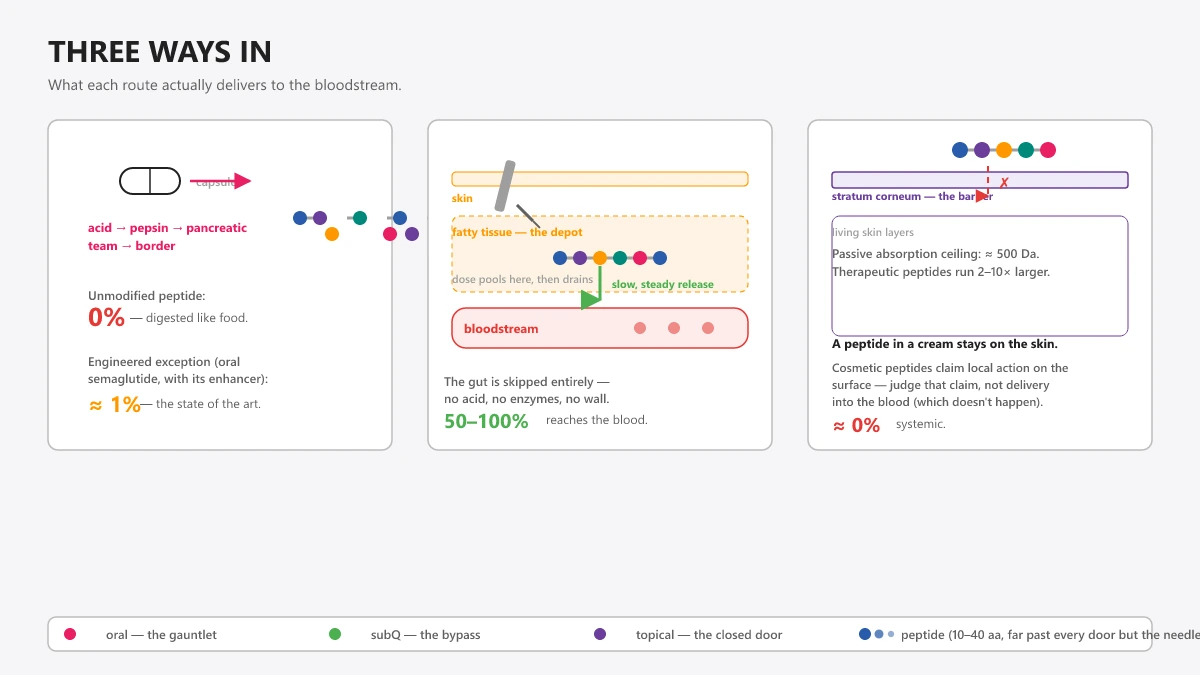
Nasal delivery is real. The tissue inside the nose is thin, richly supplied with blood, and doesn't have the digestive enzyme load of the gut. Several peptide drugs are approved as nasal sprays — desmopressin, nafarelin, and salmon calcitonin among them — and have been for decades. It's a genuine route — with caveats: absorption is typically still only a few percent, it varies between people and between doses, and congestion or technique changes the amount delivered.
Sublingual is mostly overclaimed. Under-the-tongue absorption works for small, fat-soluble molecules. Peptides are neither small nor fat-soluble. A few products have real data; most rest on the assumption that bypassing the stomach is sufficient, which the second-wall problem above shows it isn't.
Transdermal is essentially closed. Skin is one of biology's better barriers, and passive absorption through it has a rough size ceiling of about 500 daltons. Most therapeutic peptides are two to ten times that. Getting a peptide through skin requires active assistance — microneedles, electrical current — not a cream. A peptide in a topical base stays on the skin.
(Cosmetic peptides in skincare are a separate question, because those products claim local action on the skin surface rather than systemic absorption. Judge those on whether the local claim holds up — not on whether the molecule reaches your bloodstream, which it doesn't.)
The size question
Notice what kept coming up: size. Too large for the absorption transporter. Too large for the tight junctions. Too large for skin's 500-dalton ceiling.
Size determines what a peptide can physically do. It turns out size also determines something else entirely — a molecule's legal identity, its approval pathway, whether generic versions can exist, and whether a compounding pharmacy can legally touch it.
There's a specific number where all of that changes. It's 40, and it's the subject of the next article.
This article is educational and not medical advice. It does not recommend any compound, dose, or protocol. Decisions about any therapy belong with a qualified clinician who knows your history.